


Your child can now get an answer to almost any homework question in seconds, thanks to artificial intelligence (AI). No flipping through textbooks, no lengthy research, and sometimes, no real thinking involved. But if AI can do so much of the work, what should students actually be learning? As AI becomes more common in schools, this is a question parents and educators can no longer afford to ignore.
Preparing children for the future means looking beyond digital skills alone. At GIGIS, we believe students need to develop the confidence to question information, solve problems independently, and use technology responsibly. These priorities shape how we prepare students to learn, adapt, and thrive in an AI-driven world.
Before students can confidently use AI in school, they need to understand how it works and the thinking behind it.
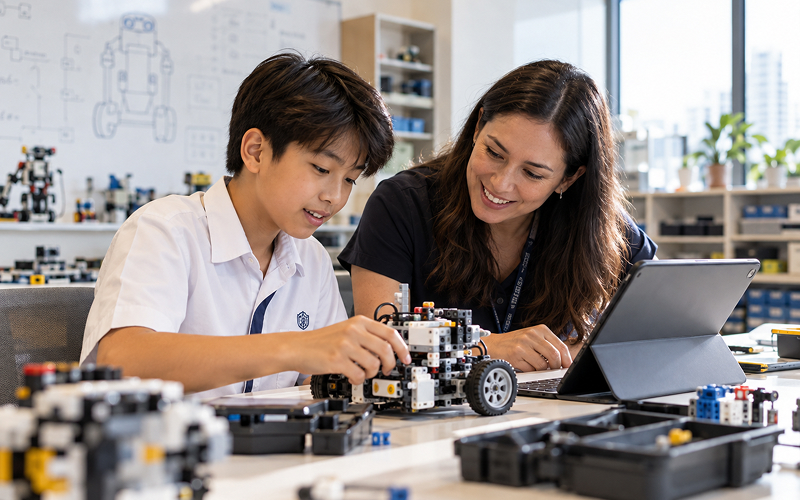
At GIGIS, we teach Information and Communication Technology (ICT) from Primary through the Cambridge Lower Secondary Programme. Students can also explore Robotics, Artificial Intelligence (AI), Machine Learning (ML), and coding through co-curricular activities. At the IGCSE level, they have the option to study Computer Science in greater depth.
From Primary 1, we also use the Concrete-Pictorial-Abstract (CPA) approach in Mathematics and Science to help students understand concepts step by step. For example, they might first explore a problem using physical objects, then represent it through diagrams before solving it using numbers or formulas. Combined with interdisciplinary learning, this encourages students to reason through problems rather than simply memorise answers.
By developing logical thinking, pattern recognition, and problem-solving skills, students learn how digital systems follow instructions, use data, and produce results. This gives them a foundation for understanding how technologies like AI work, while recognising that their outputs are not always accurate or reliable.
AI can generate convincing answers in seconds, but they are not always accurate. There is also the risk of overreliance. A student might use AI to write an impressive essay, but can they explain its arguments or defend their conclusions independently?
That is why we develop critical thinking through enquiry-based learning and Global Perspectives from Primary 1. Students investigate questions, compare viewpoints, evaluate evidence, and explain their reasoning rather than simply accepting information at face value.
These habits also lay the groundwork for responsible digital literacy. As students encounter AI in schools and beyond, they need to understand how to:
Ultimately, we want students to develop the confidence to question information, form their own conclusions, and use technology as a learning aid rather than a substitute for thinking.
Knowing how to use technology is one thing. Understanding how to build something with it is another.
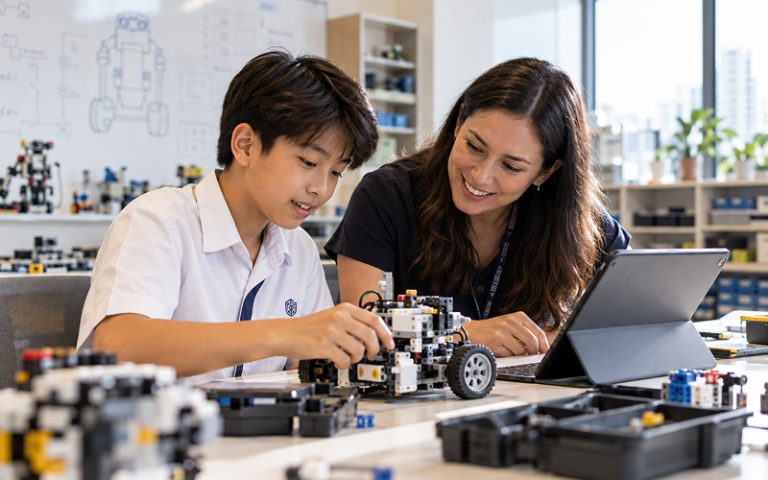
The GIGIS approach to future-ready education encourages students to move beyond being passive users of technology. Through ICT, coding-related activities, and IGCSE Computer Science, students have opportunities to develop computational thinking, which involves breaking complex problems into smaller, manageable steps.
For example, when creating a simple programme, students must work out what they want it to do, write the necessary instructions, test the results, and correct any errors. This teaches them to experiment, troubleshoot, and improve their work rather than expect everything to succeed on the first attempt.
These skills extend beyond programming. As AI becomes more prevalent in schools, understanding how digital systems process instructions and information can help students evaluate new technologies more critically and explore how they might use them to solve real-world problems.
AI might help a student create an impressive presentation, but can they confidently explain their ideas, answer unexpected questions, or work through disagreements with teammates?
These situations require human skills that go beyond knowing how to use technology. In fact, the World Economic Forum’s Future of Jobs Report 2025 identifies analytical thinking, creative thinking, resilience, and leadership among the skills employers increasingly value.
At GIGIS, we nurture these abilities through classroom discussions, group projects, Life Skills, arts, and co-curricular activities. For example, group projects encourage students to divide responsibilities, consider different viewpoints, and work towards a shared outcome. Classroom discussions also give them opportunities to explain their reasoning, respond to feedback, and reconsider their ideas when presented with new information.
These experiences give students the opportunity to:
For us, future-ready education means developing these capabilities alongside digital proficiency. After all, students will need more than technical knowledge to navigate university, future careers, and real-world situations where there is no straightforward answer.
AI will continue to change how students learn, work, and solve problems. Rather than focusing solely on keeping up with new technologies, the priority should be helping children develop the skills to navigate these changes.
Strong academic foundations, critical thinking, digital literacy, and adaptability will help students make the most of AI in school without becoming overly dependent on it. Ultimately, the goal is to prepare children not just to use technology, but to think independently and thrive alongside it.
GIGIS is an international school in Singapore offering education from Primary through to Pre-University. We combine academic learning with enquiry-based teaching, digital literacy, and holistic development through our proprietary 4Q framework.
Our approach goes beyond traditional academics, with opportunities for students to explore emerging technologies such as AI, Robotics, and coding. Combined with small class sizes and an emphasis on independent thinking, we help students develop the knowledge, adaptability, and problem-solving skills needed in an increasingly technology-driven world.
Want to understand how we can support your child’s learning journey? Contact us to find out more.
Not necessarily. There is no need to rush your child into using AI simply because the technology is becoming more widespread. What matters is whether they can use it safely, understand its limitations, and recognise when they need to think for themselves. If you’re unsure whether your child is ready, speak with their teachers about which tools are age-appropriate and how they can be used to support the development of AI skills for students without creating unnecessary dependence.
Start by setting simple, age-appropriate rules about when AI can be used for homework and what information should never be shared online. Rather than banning AI altogether, take an interest in how your child uses it. For example, you could explore an AI tool together and discuss when its answers are helpful or questionable. The aim is to build healthy habits and open communication, so your child feels comfortable asking for guidance when unsure.
Look at how your child approaches tasks without assistance. Do they struggle to explain answers they have submitted? Are they reluctant to attempt homework before consulting AI? These can be signs of overreliance. Rather than immediately restricting access, encourage your child to attempt problems independently first and use AI only when they need clarification or additional support.