
“When will I ever use this?” Your child may have asked that after a Mathematics lesson or while revising for their Science exams. It is a fair question; after all, school timetables may separate subjects neatly, but life rarely does.
That is why we use interdisciplinary learning at GIGIS to help students connect what they learn with the problems around them. Investigating water conservation, for example, could require scientific understanding, calculations, and a clear explanation of which changes would make a difference.
We want students to build strong subject knowledge and learn when and how to apply it. Here is how we bring those connections into their learning.
Interdisciplinary learning means using knowledge from more than one subject to explore the same question. It helps your child see how different lessons fit together and how to use what they have learnt beyond a textbook exercise.
For example, imagine students are asked: “How could we reduce water use at home?” They might use Science to understand why conserving water matters, Mathematics to calculate potential savings, and English to write clear, practical advice. Global Perspectives could help them consider how water access affects the choices different families can make.
Working through a question this way gives children practice in several important skills:
Seeing a practical purpose for their lessons can also make learning feel more meaningful. Your child begins to understand both how to answer a question and why the knowledge is useful.
At GIGIS, we introduce cross-curricular learning through Units of Inquiry in our Primary programme, which draws on the Cambridge Primary curriculum. These units give children a shared question or theme to explore using different subject skills, rather than treating every lesson as a separate piece of information.
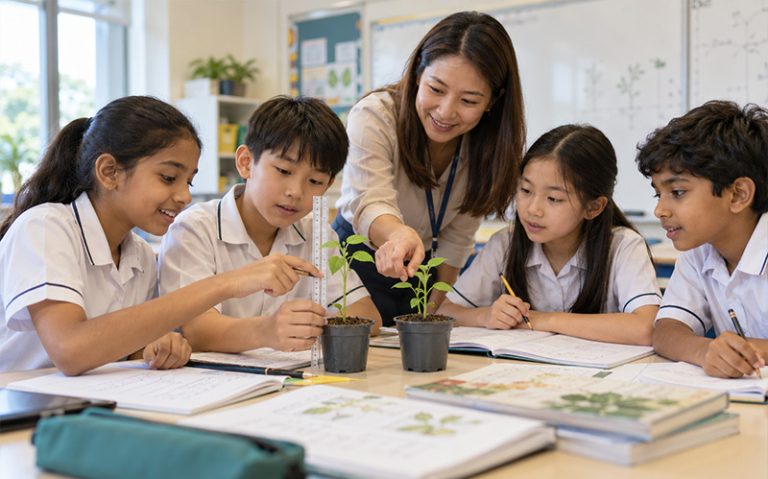
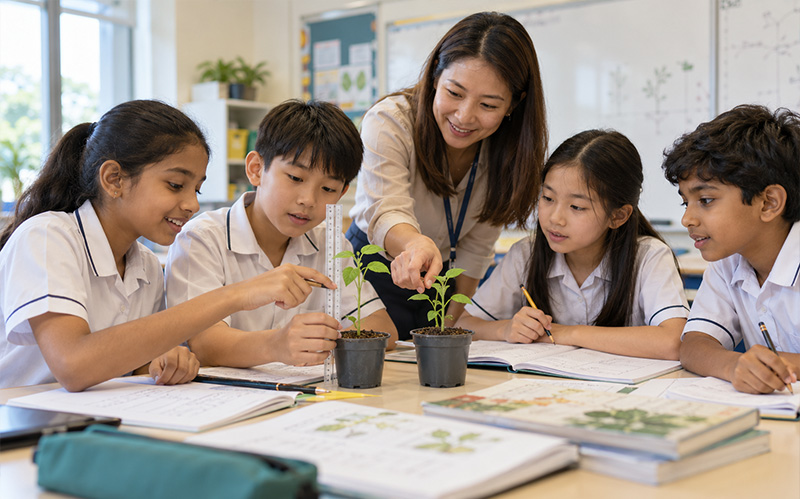
For example, a question such as “What helps plants grow?” could bring together Science, Mathematics, and English. Children might observe plants under different conditions, measure their growth, and use those observations to explain their findings. The measurements help them check whether their explanation is supported by what happened.
From Class 3, our Units of Inquiry are organised into General Science and Global Perspectives. This gives each area a clearer focus while retaining opportunities to connect scientific understanding with questions about people and the wider world. Our aim is to help children build subject knowledge and practise using it to investigate a question, support an explanation, or suggest a solution.
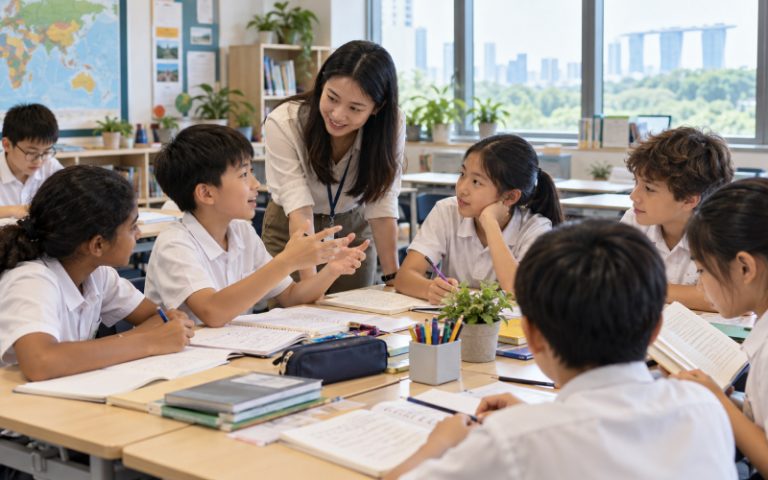
Getting the right answer matters, but we also want to understand how your child arrived there. Through enquiry-based learning, we encourage students to ask questions, look for evidence, test ideas, and explain their thinking.
Imagine students are exploring how to reduce food waste. Their first suggestion might be to serve smaller portions. After looking at how much food is left over and asking others about their needs, they may realise that offering different portion sizes would be more helpful.
Questions such as “What did you find out?” and “Would that work for everyone?” help children think their ideas through. Their answers can also show where they need support. Your child might understand the figures in a chart but need help explaining what those figures suggest they should do next.
As children grow older, they begin to encounter questions with more than one reasonable answer. Global Perspectives, which features in our Cambridge Secondary and IGCSE curricula, gives students opportunities to explore issues from different viewpoints.
Take a familiar question: how does food reach our tables in Singapore? Students could explore how crops grow, how weather affects harvests, what transporting food involves, and why prices change. They may also consider how rising prices affect families differently.
Our approach helps students bring these pieces together. Growing more food may sound like a straightforward solution, but what if it costs too much for families to buy? Working through questions like this helps your child recognise that a useful solution needs to consider both the facts and the people affected.
Projects and practical tasks give students a chance to use what they have learnt. When exploring real-world problems, they may need to research a question, organise information, share responsibilities, and explain their proposed solution.
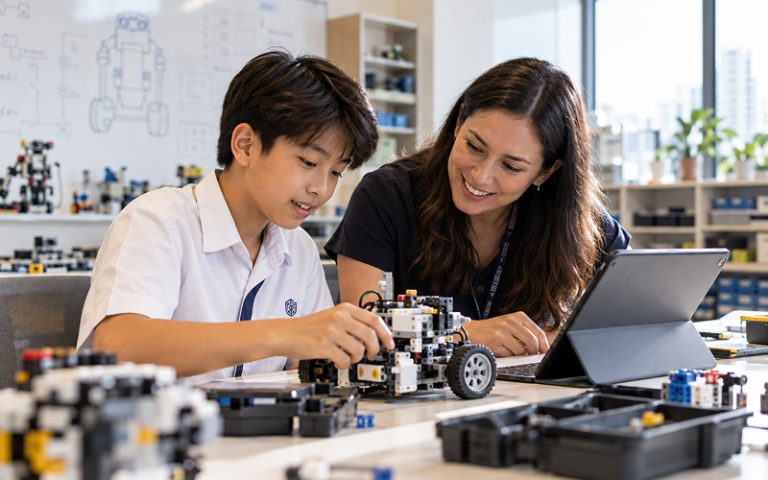
A technology project, for example, could involve writing code, testing a design, and working with classmates to improve it. When something does not work as expected, students have a reason to revisit their ideas and try a different approach.
The learning also comes through in their explanations: “We changed this because…” or “Next time, we would…” These reflections help teachers understand what each student has grasped and where more guidance would help.
Not every connection needs a large project. A classroom discussion or a short investigation can be just as useful. Throughout, strong subject knowledge gives children the tools they need to make sensible connections and put their ideas to work.
As students progress towards further study and work, they will face questions that draw on more than one subject. Learning to make those connections now gives them practice choosing relevant information, weighing evidence, and explaining their decisions.
For us at GIGIS, that is the purpose of interdisciplinary learning: helping your child move from knowing an answer to understanding how to reach one. When they can explain what they used, why it mattered, and how it shaped their response, they are beginning to put their knowledge to work.
GIG International School offers education in Singapore from Primary through to Pre-University. Our educational approach brings together academic learning, enquiry, and skills development to support students as they progress. To understand how these elements fit your child’s stage, contact our admissions team to discuss the curriculum and learning pathway.
Not exactly. Projects are one way to bring different subjects together, but these connections can also happen through discussion, research, data interpretation, case studies, or problem-solving activities. The defining feature is how students combine knowledge, rather than whether they complete a project.
No. Strong subject knowledge remains essential. Students need a solid understanding of Mathematics, Science, English, and other disciplines to make useful connections between them. This approach builds on those foundations rather than replacing them.
As students progress towards IGCSE, Cambridge A and As levels, university, and work, they increasingly encounter questions that require several kinds of knowledge at once. Bringing subjects together gives them practice combining evidence, analysis, and communication to tackle more complex academic and practical challenges.